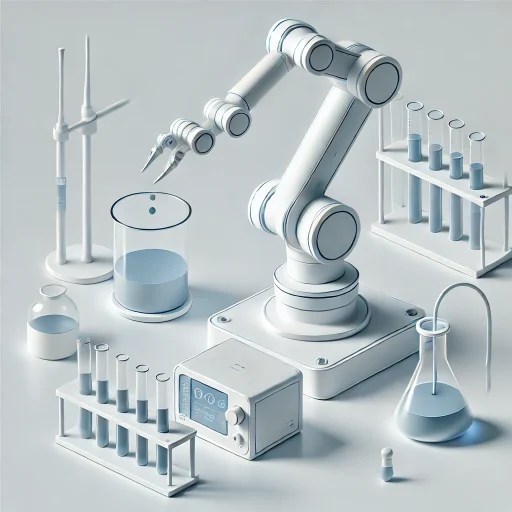
Developing new materials for critical applications requires time-consuming testing and experimentation to determine their long-term performance and integrity. Materials used in extreme environments require long-term reliability, as repair is often not feasible. Traditional materials discovery workflows based on a trial-and-error approach must be replaced by a more efficient data-driven process that could accelerate the deployment of new materials for various applications. In this post, I review three publications highlighting the new predictive science based approach to materials discovery.
The new frontier in materials design and development is based on the use of predictive science-based multiscale modeling techniques [1] combined with the use of Artificial Intelligence (AI), High-Performance Computing (HPC) [2], and robotics for autonomous experimentation [3]. The paper titled “Materials integrity in microsystems: a framework for a petascale predictive-science-based multiscale modeling and simulation system” [1] uses these techniques to illustrate the design of multiscale modeling and simulation systems for determining the long-term performance of microsystems. Microsystems are an integral part of many applications ranging from medical science to aerospace, and this paper illustrates the use of predictive science-based techniques for evaluating the performance of gyroscope microsystems through detailed analysis of radiation damage, thermal cycling, and thermal loading. One of the most important aspects of this heterogeneous computational workflow for materials discovery is bridging the gap between various length and time scales using different techniques such as molecular mechanics, phase-field modeling, micromechanics, and continuum mechanics (where the atomistic properties are tuned using quantum mechanical calculations). The use of Petascale computing is also emphasized, which is necessary to span the space and time scales, thereby reducing the uncertainty in predicting the long-term reliability of the microsystems. It is also noted that validation, verification, and uncertainty quantification are important for the software development process of the integrated software system.
The second paper, titled “Accelerating materials discovery using artificial intelligence, high performance computing and robotics” [2], illustrates the use of AI, HPC, and robotics to accelerate the discovery process in materials science. In this paper, the example of developing more sustainable photoacid generators for chemically amplified photoresists illustrates the above-mentioned predictive science-based techniques. This paper describes a prototype for the future of accelerated materials discovery, which is heterogeneous and involves linking multiple distinct capabilities over different geographical regions. This was enabled by the OpenShift hybrid cloud computing framework linking computational resources from three different continents. This is expected to become essential to the globalization of materials discovery and enhanced collaboration between researchers worldwide.
The third paper, titled “Autonomous experimentation systems for materials development: A community perspective” illustrates the use of autonomous experimentation in materials science. This approach uses predictive science-based technologies such as high-throughput experimentation, machine learning, and robotics to accelerate the discovery and development of new materials. The paper highlights the need for a comprehensive framework to integrate various elements of experimentation, such as experimental design, execution, data analysis, and decision-making, thereby making the entire workflow autonomous. Such an autonomous, high-throughput experimentation system must reduce the cost of materials development. One of the challenges in this predictive science-based technique is generating large amounts of high-quality data for machine learning. Another challenge of autonomous experimentation is the complexity of the experiment itself, which often involves numerous control variables.
In conclusion, developing predictive science based multiscale modeling and simulation systems leveraging Artificial Intelligence, High-Performance computing, and autonomous experimentation can accelerate the materials discovery and development process and possibly replace the current trial-and-error-based experimental discovery process altogether. Predictive multiscale science can analyze complex problems, and simulation techniques can replace limited testing resources by leveraging the petascale computational power.
References:
- To, Albert C., et al. ”Materials integrity in microsystems: a framework for a petascale predictive science-based multiscale modeling and simulation system.” Computational Mechanics 42 (2008):485-510.
- Pyzer-Knapp, Edward O., et al. ”Accelerating materials discovery using artificial intelligence, high performance computing and robotics.” npj Computational Materials 8.1 (2022): 84.
- Stach, Eric, et al. ”Autonomous experimentation systems for materials development: A community perspective.” Matter 4.9 (2021): 2702-2726.
This work is licensed under a Creative Commons Attribution-NonCommercial-ShareAlike 4.0 International License.
 Theoretical & Computational Materials Science